
Sample Work
eLearning Design and Development
I typically use either a rapid prototyping or ADDIE methodology for instructional design and training project development. In this project I used ADDIE – Analysis | Design | Development | Implementation | Evaluation. The analysis stage is all about clarifying what’s the problem we’re solving, for whom, what is their existing knowledge or roadblocks, where do we want to get to, and by when.
Each project is unique, but this model is a great tool. Below I use a sample course to demonstrate how I have used elements of design and development from this model.
Design and Development Process
Design Brief
Organization: PEO Customer Service (Concept)
The organization seeks to improve customer experience and retention within its PEO (Professional Employer Organization) business model as a key revenue driver. Employees need a structured training solution that equips them with the necessary knowledge and skills to apply a customer-centric approach in their interactions with PEO customers. This initiative is time-sensitive, as it aims to prepare customer-facing teams ahead of the upcoming annual customer survey in five months, ensuring they can enhance customer relationships and support revenue growth objectives.
The training program employs a blended learning approach to balance flexibility, engagement, and skill application for customer-facing teams. This method combines self-paced online learning with interactive instructor-led sessions, ensuring participants build foundational knowledge while also having opportunities for deeper discussion and real-world application.
The design incorporates role-playing exercises, multimedia elements, and collaborative peer interactions to reinforce concepts, drive engagement, and support long-term learning retention.
The program integrates multiple learning modalities to maximize effectiveness:
– Self-Paced Online Module: Foundational e-learning covering PEO concepts through multimedia, knowledge check, and interactive elements.
– Virtual Instructor-Led Training (VILT): Live sessions led by Customer Experience (CX) champions and L&D trainers to explore specific topics, facilitate discussions, and allow for Q&A.
– Role-Playing Scenarios: Simulated customer interactions to practice applying customer-centric principles in real-life situations.
– Peer Collaboration: Dedicated forums and virtual group projects led by CX champions, fostering knowledge-sharing and community-building among learners.
The training is designed for scalability and effectiveness, ensuring that all 250 customer-facing employees receive comprehensive preparation.
Key components of delivery include:
- A structured sequence of learning, starting with a self-paced module as a prerequisite before engaging in instructor-led sessions.
- Each customer-facing employee participates in 3-4 VILT sessions, each lasting 1.5 to 2 hours, with interactive discussions and dedicated role-playing exercises around customer insights and maximizing customer interactions.
- Trainer-to-participant ratio of approximately 1:20–25, maintaining engagement while allowing personalized support.
- CX champions facilitate peer collaboration through discussion forums and ongoing knowledge-sharing activities.
Storyboarding
Storyboards help me keep the focus on your project’s goals and your audience’s needs. Since it acts as a blueprint for the design, a storyboard is a great communication tool to make it clear to everyone what elements will be used in the final product.
For a short sample of this process, I am sharing the storyboard used for the eLearning portion of the program. The eLearning experience is structured around Gagné’s Nine Events of Instruction, so that it systematically builds foundational knowledge, supports active learning, and facilitates the application of customer-centric strategies in the PEO context. This design supports skill transfer into real-world scenarios in the instructor-led portion of the program.
Learning design samples for this project

Click button to view project storyboard and other details.
Training Program Optimization
Optimizing Compliance Training for Consistency, Engagement, and Relevance
Effective compliance training is about fostering a culture of accountability and risk awareness, especially in high-impact roles. In this case study, I explore how I optimized a compliance training program, addressing challenges of consistency, engagement, and relevance.
Case Study
Organization: Healthcare Compliance
Project Type: Training Program
Brief Background: A global healthcare organization needed to revamp its mandatory compliance courses to make them “fresh and engaging”. Much of the existing training courses had been migrated from PowerPoint into self-paced eLearning and updated over time in a piecemeal fashion, resulting in training that lacked cohesion. The style of engagement was almost entirely structured around watching and listening to narrated slides. The scope of the project was 8 courses covering various compliance topics to be distributed throughout the year, company-wide or to targeted roles.
Project Goal: Revamp old courses to address challenges around clarity, consistency, and engagement for its diverse employee population. Foster a culture of policy adherence to mitigate high-risk behaviors for high-impact roles.
Primary Obstacles: The topics had legal requirements that were often presented as lengthy text-heavy knowledge components that failed to resonate across audiences or promote adherence to policies.
Strategies deployed across the program were guided by survey data, feedback from subject matter experts, interactions with learners, and completion analytics.
To create design consistency and appeal
- Templated content that was common across courses
- Standardized layouts, color schemes, fonts and navigational elements within each course
- Modernized graphics and updated visual elements to maintain a contemporary, cohesive look
To boost retention and engagement
- Used microlearning techniques by dividing content into short, focused modular formats
- Chunked and scaffolded complex or dense text into digestible, diversified interactions
To increase relevance and adherence for diverse learners
- Used storytelling: case studies, scenario-based learning and gamification to communicate purpose and benefits of policy adherence
- Transformed content related to desired behaviors into scenario-based testing and decision-based activities
- Differentiated learning with adaptive approaches: knowledge-based test-out or role-based paths based on risk profiles
Implementation & Evaluation
By implementing personalized learning paths, interactive modules, and data-driven strategies, I transformed the program into a more effective and scalable solution.
Key recommendations for sustained quality of the program:
- Intentionally structure courses to make them update-friendly
- implement project planning (gain agreement to the plan and realistic timelines at the project start and strategically adjust the timeline in order to produce a quality outcome and accommodate necessary changes).
Learning design samples for this project
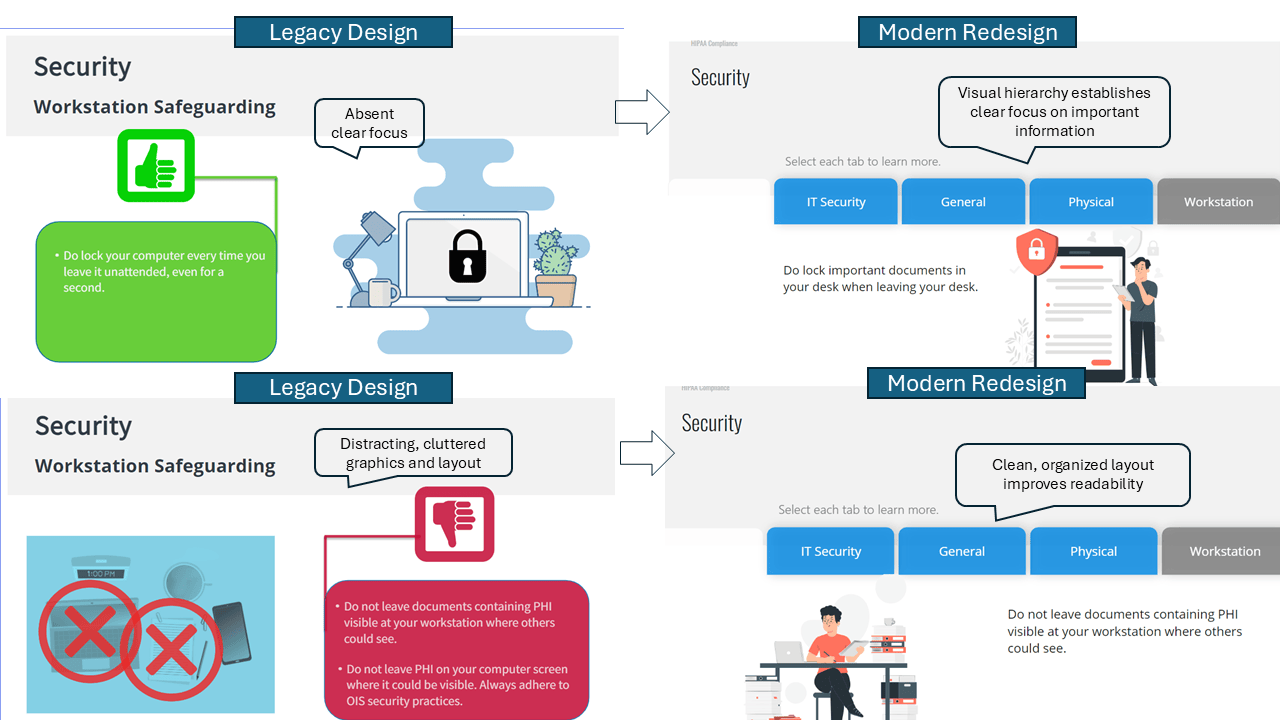
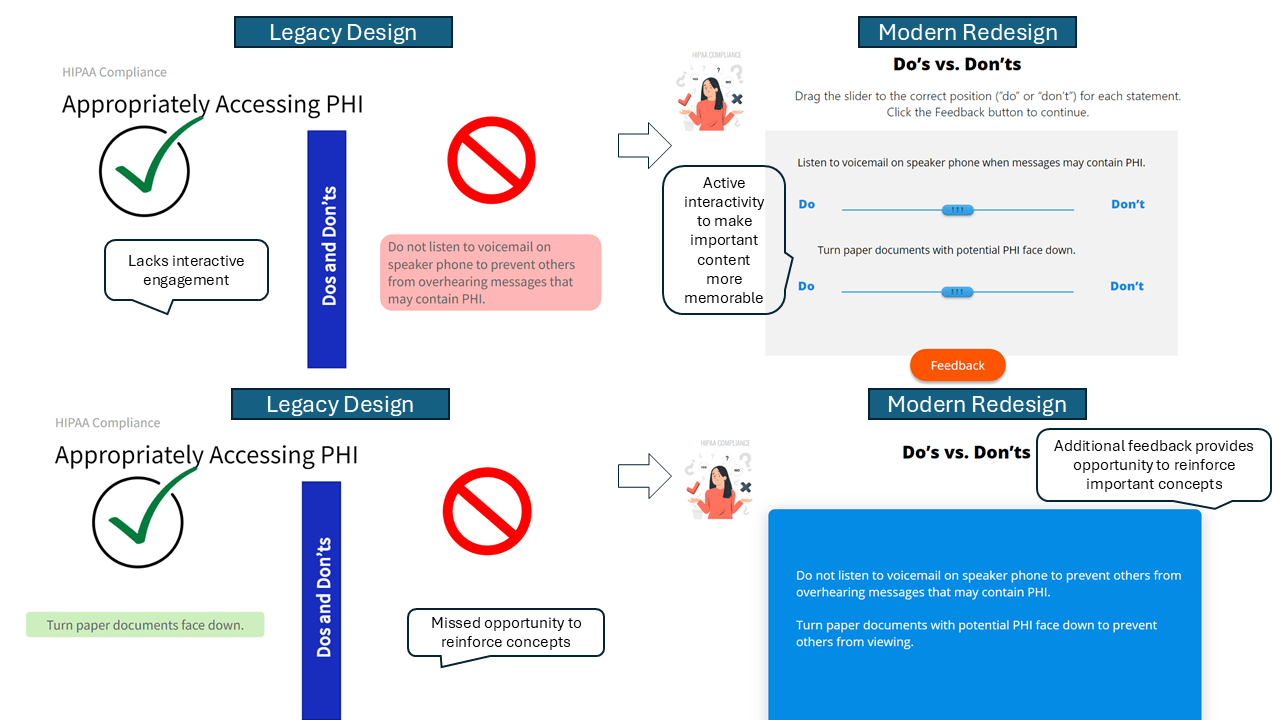
Note: Because of confidentially, I am unable to link to the final courses in this optimization project. Confidential content was removed or obscured in samples.
Project Roles
analysis, script editing, eLearning development, graphic design, visual design, video editing, learning strategy, vendor interface, project management, SME/stakeholder management, LMS administration
Tools Used
Articulate 360 Storyline and Rise, Poet, Adobe Creative Suite, Google Suite, Microsoft Office Suite, FreePik, Cornerstone (SABA) LMS, branded assets